The questions are designed so that one answer (the intuitive solution) immediately comes to mind. The correct answer is the analytical solution, however. The most common answers to Shane Fredericks' CRT questions are:
There are many decision-making activities in which it may be better to be an intuitive thinker. Other situations favor analytical thinkers. What might be better for investing decisions?
One of the principles of Prospect Theory is that people do not have a constant risk aversion. In other words, people may avoid risk in some instances and seek risk in others. For example, we buy lottery tickets (risk seeking) and car insurance (risk avoidance).
Here is another illustration. Read and consider the two choices below.
(A) $100 for certain, or
(B) flip a coin for a chance to pay nothing if heads or pay $300 if tails
Did you pick the safe alternative (choice A) for both?
The risky alternative (choice B) for both?
Or did you pick one safe choice and one risky choice?
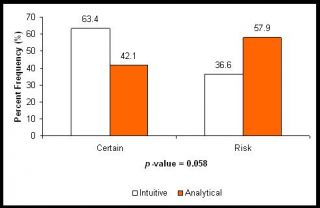
Prospect Theory suggests that the tendency will be to pick the safe option in the first question and the risky option in the second. But not everyone behaves this way. One determinant of choice seems to be the thinking mode. For example, in a sample of financial planners, I found responses for the first question to be:
Note that the intuitive thinking planners tended to pick the safe choice when receiving the money while the analytical planners tended to take the gamble. These results are similar to those found by Shane Frederick in his much larger sample of a broader segment of the population. He found that 75% of the analytical people picked the gamble while 53% of the intuitive people picked the safe option. Analytical people may recognize a risk premium in the gamble. On average, people picking the gamble will receive $150 (the expected value of $0 and $300). That is a $50 risk premium over the safe choice.
For the choice of paying money (the second question), the financial planners choose:
Here, the majority of intuitive planners picked the gamble. People are often willing to take risk in order to get back to even. The analytical planners tended toward the safe payment.
Note that both the intuitive planners and the analytical planners tended to pick one safe option and one risky option. Intuitive people picked the safe option in the positive domain (receiving money) and the risky option in the negative domain (paying money). This is consistent with Prospect Theory. The analytical planners did the opposite.
What choices would be better from an investment perspective?
1) If it takes 5 machines 5 minutes to make 5 widgets, how long would it take 100 machines to make 100 widgets? _______ minutes
Analytical answer: 5 minutes
Intuitive answer: 100 minutes
2) In a lake, there is a patch of lily pads. Everyday, the patch doubles in size. If it takes 48 days for the patch to cover the entire lake, how long would it take for the patch to cover half the lake? _________ days
Analytical answer: 47 days
Intuitive answer: 24 days
3) A bat and ball together cost $1.10. The bat costs $1.00 more than the ball. How much does the ball cost? _________ cents
Analytical answer: 5 centsIf you got two or three of the analytical answers, then you are an analytical thinker. If you got none or one analytical answers, you are an intuitive thinker. Shane found that the average number of analytical answers for Massachusetts Institute of Technology students was 2.18. Since they tend to be engineering students, this is not surprising. A Harvard choir group average was 1.43 and University of Toledo student average was 0.57.
Intuitive answer: 10 cents
There are many decision-making activities in which it may be better to be an intuitive thinker. Other situations favor analytical thinkers. What might be better for investing decisions?
One of the principles of Prospect Theory is that people do not have a constant risk aversion. In other words, people may avoid risk in some instances and seek risk in others. For example, we buy lottery tickets (risk seeking) and car insurance (risk avoidance).
Which option would you pick? You have the choice to receive either:Which option would you pick? You have the choice to pay either:
(A) $100 for certain, or
(B) flip a coin for a chance to $300 if heads or receive nothing if tails
(A) $100 for certain, or
(B) flip a coin for a chance to pay nothing if heads or pay $300 if tails
Did you pick the safe alternative (choice A) for both?
The risky alternative (choice B) for both?
Or did you pick one safe choice and one risky choice?
Prospect Theory suggests that the tendency will be to pick the safe option in the first question and the risky option in the second. But not everyone behaves this way. One determinant of choice seems to be the thinking mode. For example, in a sample of financial planners, I found responses for the first question to be:
 |
| Add caption |
For the choice of paying money (the second question), the financial planners choose:
Note that both the intuitive planners and the analytical planners tended to pick one safe option and one risky option. Intuitive people picked the safe option in the positive domain (receiving money) and the risky option in the negative domain (paying money). This is consistent with Prospect Theory. The analytical planners did the opposite.
What choices would be better from an investment perspective?

No comments:
Post a Comment