Wednesday, 30 September 2015

The Psychology of Choice


Choices can become overwhelming, so make it easier for customers.
       Imagine the following scenario: All your friends have long been involved in relationships, and you are tired of being the third wheel at every social gathering. After a few failed matchmaking attempts, you decide to try a dating  website. Soon you discover a new and exciting world that had previously been unknown to you. Suddenly you have many suitors and your dating possibilities become endless! This experience makes you feel truly attractive and desired and, without even noticing, you become addicted. But make no mistake, you are not addicted to love or dating; you are addicted to the idea of having many possibilities available to you.
The above scenario exemplifies a basic human trait: people love to have many options, even if they only exist in theory. When asked, who wouldn’t prefer to choose from a list of five different items over a list of only two? Intuitively, people feel that the more options they have, the greater their chances are of finding the choice that will perfectly satisfy their needs. But this intuitive assumption turns out to be an illusion – the more options we have, the less likely we are to make a decision at all.


To Buy… or Not to Buy
The availability of seemingly unlimited possibilities is of course not exclusive to dating sites. We live in a world of abundance, where we can find and purchase virtually anything that we want. But this wealth of choices can become an overwhelming experience.
Observations of visitor behavior on multiple eCommerce websites has shown that, when customers are given a large number of options to choose from, they have a much harder time making a decision than those who use the sites' filtering tools to limit the number of possible choices. Visitors that try to scan through all of the different products available inevitably become frustrated and leave the website altogether.  This is because having too many options causes a sort of paralysis in the decision-making process, which leads to avoidance behavior – i.e. choosing to do nothing at all. In the instances when a choice is made under these conditions, it is usually accompanied by frustration.
Professor Sheena Iyengar discusses this phenomenon in her book “The Art of Choosing.” A grocery store presented customers with two different sampling stations: one with 24 flavors of jam and the other with only six options. The results of the study revealed that the availability of six options resulted in 30% of consumers purchasing at least one jar of jam, while the sampling station with 24 flavors had a conversion rate of only 3%. While the larger selection attracted more onlookers, the smaller selection actually generated more sales.


Why does this happen?
When we are presented with many options, we usually fear making the wrong decision. This can be translated into simple math – when there are only two options, we have a 50% chance of choosing the right one. But when there are five options, our chances suddenly decrease to 20%. Matters become even more complicated when there are twenty options or more. Human cognitive ability cannot efficiently compare more than five options, so most of us will start looking at the first few options and then stop.
Awareness that there may be a better option triggers the urge to find it. However, due to time constraints and human cognitive limitations, we are unable to engage in the elaborate thought process required to compare and contrast all of the available alternatives.
The ‘ever-changing reference point’ is another factor that plays a role in the selection process. Whenever a new alternative is made available, the reference point is changed, thus creating a new perspective for the customer.
 Imagine you are looking to buy an iPad on eBay. Before viewing the different items on this category, you limited your search results to include only devises that cost $100 – $150. After viewing the first four devises which met your basic expectation, you suddenly see the same devise as the first four but with expended memory.  Suddenly, your standard level changes. “Oh,” you think, “I can get an iPad with expanded memory for this budget, why should I settle for less?” Your comparison criteria have changed. From that point on, you will compare all other devises to the one with the expended memory. Your reference point changed, effectively making your choice a one-way street. Once you take it, you cannot go back to your original reference point and settle for less.    
Visitor behavior on a recipe website tells the same story; the presence of too many options interferes with our ability to make a decision. When selecting a recipe from the “Cakes” product page, visitors were observed to have a very difficult time reaching a decision -- until the options were artificially limited, at which point the percentage of clicks increased significantly. It’s worth noting that the observed mouse move level was high for both versions of the page, meaning that the items were considered carefully, but the large selection harmed the decision making process. This behavior demonstrates that even when fulfilling one of our most basic and primal needs, an excess of options can prevent our cognitive systems from processing the information efficiently. The system becomes overwhelmed and the decision-making process is disrupted.
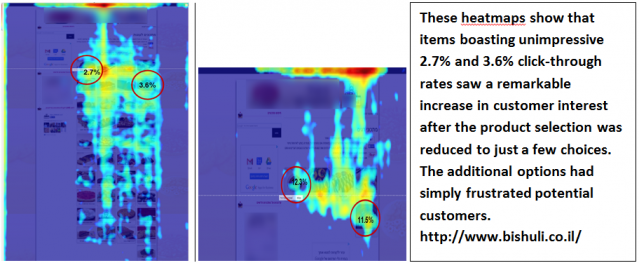


The heatmap was taken from Bishuli - Cooking Blog


How can businesses benefit?
Businesses must intelligently limit the number of options that are presented to customers.  This doesn’t mean dramatically cutting the number of options available, but rather presenting them wisely, as an in-store sales representative would do when assisting a customer.  There are several efficient methods for easing the selection process and giving the customer the direction he needs.
One good way to avoid cognitive overload is to ensure that no row contains more than five items, and to format the page such that each product is enlarged when the customer places his mouse over it.  This will separate the items in each row from the rest of the items on the page, as well as making each product stand out as a separate unit. Our brains then register the decision making process as a manageable task, and assign the required cognitive resources.
Another efficient method is filtering, which allows the customer to drill down to the most relevant options.  This is similar to an in-store customer service representative telling you, “Let me know what color and size you need, and I will bring it to you.” Companies can also structure the choice to make it easier for visitors to search for a good alternative; for example, they might arrange the information on a store page to align options by brand, purpose or mood (romantic, sexy or fun). 
Providing a ‘default’ or ‘suggested’ option is another proven method of helping customers stay focused.  It tells the customer, “This item fulfills all of your basic needs and it is sold for a reasonable price.  Most of our customers choose this one.”
Social comparison can also be used as a facilitator, as in “Most visitors who share your profile choose this option” or “Customers who viewed this item also looked at these other options.” These sentences are socially oriented, helping the customer to feel like part of a group and thus fulfilling our basic need of wanting to ‘belong.’  This relates to another strategy often used by brick-and-mortar sales reps: using statements like “Business women usually pick this bag” so potential customers will unconsciously associate a product with a group they would like to be a part of.
Most people welcome help when making a purchasing decision, as long as it is not pushy. Digital media is the perfect platform to address these needs, because it allows businesses to provide their customers with appropriate guidance and direction while taking into account their cognitive limitations.


Tuesday, 29 September 2015

Men Systemize. Women Empathize.

There are inherited differences between the cognitive style of men and women.
Successful product marketing is looking at products and services from the customers’ or users’ point of view. User-centered design (UCD) optimizes products for how users need to use them, rather than forcing users to change their behavior to use a product.
An important variable that we can use to differentiate between users is gender. Research has provided evidence that there are inherited differences between the cognitive style of men and women—in other words, the way men and women think, perceive, and remember information.
Girls Watch Faces. Boys Watch Objects
ClickTale

Female babies give attention to social stimulations such as human faces and voices—females are stronger empathizers.
According to Simon Baron-Cohen, there are observable differences between how boys and girls behave at birth. While most female babies give most of their attention to social stimuli such as human faces and voices, the majority of boys pay most attention to nonsocial, spatial stimuli—such as the movement of a mobile hanging above a crib. Throughout their lives, male and female individuals continue to manifest these early traits in more and more complex ways.


Systemizing vs. Empathizing
ClickTale

Boys pay attention to spatial stimuli such as movement. Males are stronger systemizers.
In general, females are stronger empathizers and males are stronger systemizers. A growing body of evidence suggests that males spontaneously systemize to a greater degree than females do, while females spontaneously empathize to a greater degree than males.
Other studies have also suggested that mathematics, physics, and engineering—all of which require a high degree of systemization—are more commonly male occupations, while women are better at decoding nonverbal communications, picking up subtle nuances from tone of voice or facial expression, or judging a person’s character. Obviously, this does not mean that all men are systemizers and all women are empathizers!


The Proof is in the Pudding
The analysts at ClickTale conducted a study of how men and women behave on a recipes Web site. From the ClickTale heat maps it was possible to discern a number of points to back up the systemization versus empathizing theory:
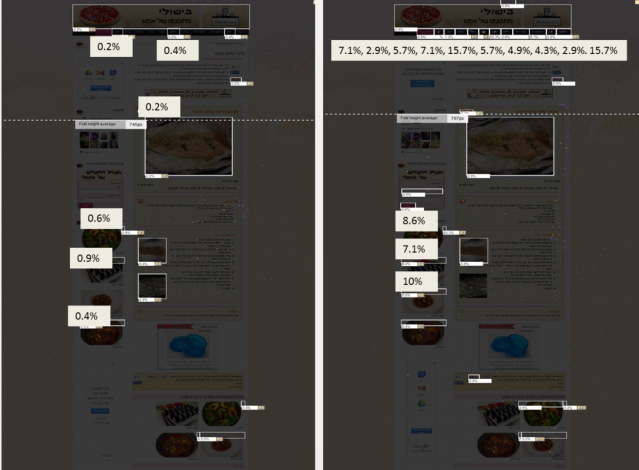
From the side-by-side mouse-click heat map presented here, you can see the percentage of Web site visitors who clicked on various parts of the page. Men are in the left-hand heat map while women are shown in the right-hand heat map.
ClickTale
Source: ClickTale
ClickTale mouse-click heat maps comparing male and female clicking behavior. Men are shown on the left heat map; women, on the right.
At first glance, it’s clear that many more women were engaged with the top menu bar, clicking into the various categories to view the different food recipes. Also, women were more likely to click on the left-side icons rather than stay solely on the recipe. Men, on the other hand, tended to be far more limited in their clicks, they search exactly for what they came for and then leave the site when they are done.
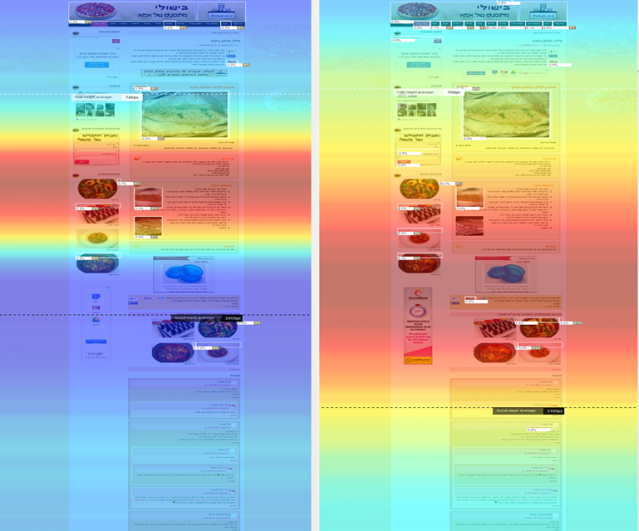
See the side-by-side attention heat maps comparing male attention on the web page (left) and female attention (right).
ClickTale
Source: ClickTale
ClickTale Attention Heatmaps comparing Male and Female attention on the page. Men – shown on the left heatmap, Women – on the right
As seen by the narrow ‘hot’ band in the center of the page, men were very focused on the ingredients of a recipe and how to prepare it, women, on the other hand, browsed up and down the page more and were less focused – as seen by the wider, more diffused ‘hot’ band.
Both heatmaps confirm that men were far more systematic in their behavior on the site while women fit far more the empathizing cognitive style.
Implications for Website Design
Gender differences impact many aspects of life—one being shopping behavior.
A study titled “Men Buy, Women Shop” revealed significant differences between the shopping behaviors of men and women. According to Wharton’s marketing professor Stephen J. Hoch, “Women think of shopping in an interpersonal, human fashion, and men treat it as more instrumental. It’s a job to get done,” he says, adding that this data has implications for businesses that are interested in developing a more segmented approach to building and maintaining loyalty among male and female customers.
The study found that women are more focused on the experience, men on the mission.
Women react more strongly than men to personal interactions with sales associates, while men are more likely to respond to the more utilitarian aspects of the experience—such as the availability of parking, whether the item they need is in stock, and the length of the checkout line.


So how can we apply these observations to website design, the online experience and customer journey?
Here are some examples of how the online behavior of men and women reflects their different cognitive styles and what distinguishes their interactions with Web sites:
Reasons to go online—Men are more oriented toward impersonal or individualistic goals. Women are more oriented toward social integration. While women enjoy the browsing process, men are more task-oriented and focus on how well they are able to accomplish a task and find what they are looking for.
<a href="http://affiliate.edmedia.in/?ref=5" target="_blank"><img src="http://affiliate.edmedia.in/wp-content/uploads/2017/10/300X300-Floral-Designs.png" /></a>

Website type —Women focus on socializing and communication, spend more time doing social networking and writing email messages, while men care more about functionality and are more likely to use a website as a tool—for example, to check the weather; get news, sports, political, and financial information; or download software.
Attention— Women are much more concerned about online security. They tend to need more information to make a decision—which ties in with the results of the ClickTale analysis that shows women read more pages than men—prefer different colors, read more ad copy, read stories in details and care more about bargains. Men, on the other hand, tend to be more impulsive shoppers, prefer headlines and bullet points, and are less concerned about shipping costs than women.


Conclusion
Segmenting by gender is crucial if businesses are to make their websites more enjoyable, empower their visitors, and ultimately, increase their revenues. This does not mean, however, that gender-based segmentation should lead to websites that are only for women or men. But wedo need to pay careful attention to the gender demographic of our web visitors and avoid designing websites that don’t cater to the dominant gender visitor      
      

Monday, 28 September 2015

Why Are the Candy Crushes of the World Dominating Our Lives?

Darwin goes searching for the gas pedal in this evolutionary phenomenon of his.     
What happens when an organic form of existence, after evolving for millions of years, meets the last word in planned and designed addictiveness?  Darwin goes searching for the gas pedal in this evolutionary phenomenon of his.
Smartphones have turned tens, if not hundreds, of millions of people around the world into players of videogames such as Angry Birds, Temple Run, or Candy Crush.  But as the games made their way to everyone’s pocket, reports of addiction to them also escalated.
The official position of the American Psychiatric Association is that sufficient data does not yet exist for determining whether a true addiction is involved.  But today reports are already widespread of mothers who were too engrossed in playing Candy Crush to remember to pick their children up from kindergarten, and many people testify that they feel addicted to casual games.  A survey by Ask Your Target Market found, among other things, that 28% play during work, 10% have found themselves arguing with their near ones about wasting time on playing, and 30% consider themselves addicted.

What exactly gives these games such a dramatic influence over people?

How does crushing candy differ from old-fashioned games?

In contrast to childhood games that involved human partners, or at least involved manipulating real objects in real space, smartphone games require nothing.  A central part of the expected gratification in old-fashioned games was deciding which game to play this time and making preparations (setting out the playing pieces, arranging the dollhouse, assigning characters, or determining who takes the first turn).
Even videogames for computers and for consoles are an entirely different matter from smartphone games.  In videogames, we generally assume a masterful role such as superhero, soccer player, warrior, or the like, fulfilling a fantasy and giving our senses and emotions an experience.  Such games boost adrenaline levels, and they awaken strong feelings of power as well as frustration, gratification, and enjoyment.
Playing smartphone games does not result from a desire to take part in any shared activity or to achieve any fantasy.  Their gratification derives from a change of mental state, a sort of detachment.  To select the app and start the game, no investment is required, no thought or intention, but merely the urge to play.
The urge appears just as hunger or thirst does.  Like them, it requires no handling in depth and no thought process.  Our primitive urges arrive from lower-level areas of the brain, such as the limbic system, which is involved in emotions and motivation.

How is the urge created?

The game designers seem to have arrived at a winning formula, dubbed the “ludic loop” and based on the fundamentals of behaviorism.
The principle is simple.  Significant feedback, in response to an action, encourages behavior that is repetitive if not obsessive.  A slot machine can provide a perfect representation of how the ludic loop encourages obsessive behavior.  You perform a particular action and receive reinforcement:  the machine responds with lights, changing colors, noises, and sometimes a monetary reward.  That reward causes us to repeat the same action again and again.
A smartphone game is generally simple and easy to understand, and it requires no cognitive resources, so that children and adults alike can easily understand the basic principles.  At the start there is a system of learning by stages, whereby each time the level of play advances a bit, the challenge is revivified and thus the ludic loop is renewed and the desire to continue receiving those fresh doses of gratification causes us to play again and again.

Opening the dopamine faucets

Our attraction to this kind of action is attributed to the neurotransmitter called dopamine, a chemical found in our brain.  Initially scientists associated dopamine with feelings of enjoyment (a high level of dopamine being visible during activities such as eating chocolate, sex, and hearing favorite music) but research in the past decade has indicated that dopamine has additional functions besides activating gratification and pleasure.  This molecule helps us in pattern recognition and it alerts us — by dropping to low levels — to a deviation from the familiar pattern we’ve learned (to a surprise, in other words).
The system centers around expectations.  Dopamine cells are constantly creating patterns of action based on experience.  After repeatedly crying and each time hearing Mommy’s steps approaching quickly in the corridor at the sound, the baby internalizes a pattern whereby crying receives a positive reinforcement (Mommy) and the dopamine level in the baby’s brain increases in response to Mommy’s footsteps even before she arrives.  Each time the dopamine cells predict wrongly (Mommy doesn’t arrive) the brain sends a special electrical signal called the habenular signal in response to the erroneous prediction.
The purpose of these cells is to predict events.  They always want to know which actions foretell a reward.  From the dopamine cells’ standpoint, the virtual world is no different from the real world.  Gambling machines and smartphone games are patterns to be predicted and identified.
When we are playing at a gambling machine or at Candy Crush, our brain cells strive to decode the mechanism’s pattern of action.  They want to understand the game, to decode the secret of success, to discover the criteria that predict an upcoming reward.

Expecting a rerun, excited by surprise

Although the dopamine cells respond when they recognize a familiar pattern, they are more excited at unexpected rewards (three or four times as excited, as measured by the strength of the dopaminergic firing).  In other words, the reward is more pleasurable the more surprising it is.  A burst of dopamine, intended to turn the brain’s attention to new stimuli, is important to survival.
The reaction to the unexpected has strongly roots in our evolution.  When we receive unexpected cash on a randomized basis, it forces us more strongly into obsessively repeating our action than cash on a predictable basis would.  The behavior was demonstrated by Skinner, one of the pioneers of behavioral psychology in the 1950s.  When his lab rats received an unexpected reward from pushing a pedal, they would continue pushing it even after the reward stopped arriving.  Once a causal relationship was established, it stubbornly retained its force.

Technology defeats evolution
Although the dopamine cells that deal with prediction try to understand the game’s reward system, they are fated for surprise time after time.  From the dopamine cells’ standpoint, the stakes are life and death:  in order to survive in the world, they need to identify its patterns.  They ought to give up on the gambling machines and similar games in order not to waste their dopaminergic strength on phenomena that have proven quite unpredictable, but instead of losing interest in random rewards, the dopamine cells become addicted to them.  When we receive the reward, we experience a burst of pleasurable dopamine deriving largely from the unexpectedness itself.  The dopamine cells cannot crack the pattern, they cannot accustom themselves to it, and they cannot learn or internalize it.

The illusion of control

Gambling machines and games like Candy Crush are not always governed by rules or control.  The player may have the impression of understanding the game, and may try to construct a strategy, but the random fruits that encourage that impression issue from a generator by no set pattern or comprehensible algorithm.  They obey nothing but a dumb little chip that produces numbers by what is known as engineered randomness.
In this type of game, the randomness treads the fine line between the purely random and the illusion that control is available to whoever discovers a certain hidden logic.  Such a pattern encourages the player to think it is possible to plan upcoming moves strategically.  The false sense of controllability is a powerful motivator.  When people enter its circle of power, they can be made to repeat the same behavior again and again even with no reward and with no apparent stopping point.  There is no specific goal, but only the pleasure of the little emotional roller-coaster.  The game creates pleasure from within itself.

The little Mary Poppins in each of us

Although game theory is still in its infancy, psychological insights are already embedded in game design according to a certain formula for success.  We are aware of the basic components underlying addiction.  Those components can explain the similarity among such popular games as Tetris, Bejeweled, and Candy Crush.
Matching and arranging random shapes that appear on the screen — attempting to find a pattern based on shape, or to arrange shapes in a way that fits —is beyond question a tool for gratification and pleasure at the deepest level. Matching shapes or patterns is a basic human obsession, drawing from the same source that encourages babies to fit shapes into holes.  We have a basic need to arrange objects.  It seems that the urge to tidy up a mess and restore the status quo ante resembles a sense of mission.  Arranging objects on the screen feels like setting matters right and restoring order.

And a point of positivity to end on

The purpose of exploiting pleasure-giving mechanisms does not need to be something like encouraging addiction.  The limbic loop can help in treating or preventing psychological damage.  Playing Tetris after watching a disturbing movie has been found to reduce the likelihood of flashbacks.  Games that encourage obsessive behavior can serve as a cognitive immunization against post-traumatic stress disorder.  Furthermore, the more stressed our society becomes, the more we require stress relievers, and particularly those we can carry with us everywhere.  

Sunday, 27 September 2015

The Human Psychology behind Facebook’s Success


Facebook has become an addiction due to its ability to meet our basic needs
The past few years have been a time of incredible growth for social media in general, and Facebook in particular. The fact that the site has even topped Google as the most visited site in the U.S. suggests that Facebook has become an integral part of how people connect and communicate with the world around them.
Facebook allows registered users to create profiles, upload photos and video, send messages and – above all - keep in touch with friends, family and colleagues. However, Facebook’s ability to keep people connected is only part of the reason for its massive success. The truth is that Facebook allows us to connect not only with loved ones, but with our fundamental human needs. The same way that grocery stores are habituated into our routine to meet our need for physical sustenance, Facebook has become a daily destination for millions due to its ability to meet our need for psychological fulfillment.
Self-esteem
Self-esteem is considered to be one of the determinants that shape our psychological well-being. Self-esteem is in large part based on our self-schema, a model that organizes information about ourselves and reflects what we think about, care about, and spend our time and energy on. If, for example, “being an athlete” is not an important aspect of your self-schema, then arriving last in the school’s running competition  wouldn’t influence your self-esteem.However, if “being smart” is an important aspect of your self-schema, then scoring low on an exam would negatively influence your self-esteem.
Our Facebook profiles are micro-reflections of our self-schemata. In addition to our appearance, they include information about our hobbies, education level, number of friends, things we care about and so on. Thus, Facebook can unconsciously increase our self-esteem by providing us with the opportunity to reconstruct and control the way we present ourselves to the world. Furthermore, unlike public message boards, Facebook allows us to block any “trolls” whose insults and mean-spirited discourse threaten our self-assurance. 
Impression management 
Impression management is the process through which people attempt to influence others’ perception of their image by regulating and controlling information during social interaction. It is considered a key building block in interpersonal communications, with the goal of enhancing desired traits.
Facebook, like most online interactions, allows the user to exercise a great deal of impression management. First of all, unlike face-to-face conversation, Facebook gives users as much time as they need to prepare a thoughtful or witty status update or wall post. Additionally, the influence of nonverbal behavior is entirely eliminated in the online arena.
As a result, we have developed a set of explicit and implicit signals to help us form impressions of other Facebook users. The explicit signals consist of clear-cut measurements like number of friends, perceived quality of friends and education level. The implicit signals are more subtle: frequent relationship status updates can imply instability; frequent profile photo changes and new posts can indicate an extroversion tendency, and frequent ‘like’-ing of others’ content can indicate ingratiation attempts. Furthermore, the decision not to share information like relationship status and gender of interest reveals even more about the user than the information shared!
A 2004 study by Samuel D. Gosling and Simine Vazire of the University of Texas found that Facebook profiles provide the observer with just as much information about the users’ personalities as their bedroom or office.  Also, our initial interpretation of a user’s personality is accurate in most cases, and is revealed within the first few minutes of the interaction.
Thus, Facebook can influence our self-esteem by giving us the opportunity to control the way we present ourselves through the process of impression management – it can influence the way other people perceive us but most importantly, it can influence the way we perceive ourselves.
We put a lot of time and effort into this self-customization because, on a subconscious level, we are re-inventing a more positive version of ourselves. This is reflected in the composition of our carefully selected profile elements. We present our most attractive photos; list favorite movies, music and books that we feel will impress others; and send friend requests to not only our friends and family, but to the people we respect and want to be associated with.
Self-perception theory (SPT) asserts that people develop their attitudes by observing their own behavior and then making conclusions about the attitudes that must have been responsible for the behavior. Thus, the individual interprets his own overt behaviors rationally, in the same way he attempts to explain others’ behaviors. This helps to explain how one’s own Facebook profile can promote positive self-perception and contribute to our psychological well-being.


The need to belong
 Roy Baumeister and Mark Leary (1995) argue that “the need to belong is a fundamental human need to form and maintain at least a minimum amount of lasting, positive, and (significant) interpersonal relationships. Satisfying this need requires (a) frequent, positive interactions with the same individuals, and (b) engaging in these interactions within a long-term framework….” In today’s world, social networks like Facebook fill this need.
Facebook gives its users a sense of belonging by co-opting familiar concepts that already hold strong cognitive associations. One such concept is ”friends.” This word is now used to describe a new form of relationship: two people linked through the Facebook platform. By introducing the user to a familiar concept that is already emotionally charged, Facebook ensures that our pre-existing associations with the word are automatically linked to the new concept. It actually takes advantage of everything that the concept of “friend” stands for and blurring the line between real and virtual relationships. 
Another example for Facebook reliance on familiar concepts is the term “photo album”. A well-established concept that immediately associates with our closest social groups (mostly family and friends). This concept is emotionally charged and generates a sense of closeness and belongings.


Facebook Enables Our Personality Traits
Facebook provides its users with an immediate vent for our needs and obsessions. For example, Erica Dawson found that extroverts tend to update their profile photos, status, and information they reveal about themselves much more frequently than other users. Thus, Facebook allows them to act out their hidden desires without the fear of being perceived as arrogant or narcissistic. Imagine a person asking people to look at his photos at a social gathering, or telling everyone how many friends he has; he would immediately be perceived as breaking social codes. On Facebook, however, it is considered a legitimate activity.


Summary
 For many people, Facebook has become an integral part of their everyday lives.  In other words, it’s a habit: a routine of behavior that is repeated regularly and tends to occur unconsciously. The formation of every habit we adopt is triggered by a conscious or unconscious reward, which helps our brain decide if a particular action is worth remembering for the future. Thus, we may originally register on Facebook in order to be connected to our friends but, without realizing it, the site becomes a habit because we discover that it provides us with subconscious psychological rewards. Over time, this loop becomes more and more automatic as it is imprinted in our neural pathways. The result? 1.23 billion monthly active users

Saturday, 26 September 2015

To Like or Not to Like: Facebook’s Proposed New Button


Does the button offer more nuanced emotional expression or meaningless clicking?
Mark Zuckerberg is talking about introducing a dislike button on Facebook. He describes the intention behind it as creating an appropriate positive response when the concept of "liking" doesn't fit or is too superficial or flippant.  In other words, we don’t want to "like" a post about loss or hardship, but we might want to express concern and support.  To date, this has been done in comments, not with a button.
The implications of a dislike button (or whatever it is ultimately called) are layered. First, how will Facebook users react and click?  Second, how will the marketers figure out what the consumers are actually doing so they know how to adjust their ad strategies?

What's In It for Users?

The ability to express emotions to what other people post matters to users.
  • The new button gives people an additional way of expressing empathy for others—this makes them feel more connected.  Expressing connection—whether liking or with solidarity—is an exchange of social capital that creates a psychological bond.
  • Even the simple act of clicking increases engagement.  To click or not to click? Taking action demands a thought process necessary to generate an action.  We think, therefore we're in.  People do not thoughtlessly or routinely like (nor will they dislike) every post.  Now they have to think in a more nuanced way than just Like or nothing.  The new button makes it a question of “what kind of emotion do I feel?” On the other hand, the human brain is lazy.  For issues with marginal personal relevance, the increased cognitive burden of deciding may eliminate a click altogether.
  • Expressing emotional experiences and getting feedback from others can be validating.  In the case of grieving, it can help someone make sense out of hardship and to begin to frame it in a way that facilitates grieving and meaning.  Having support from friends can turn challenges into positive growth opportunities because even the simple click by others demonstrates social capital that exists in spite of whatever is going on.  In the case of a cause or belief, social validation and affiliation normalizes and strengthens commitment.
There are potential downsides.  For example:
  • If the button is culturally appropriated, no matter what it says on its label, and used as a sign of rejection or "dislike" rather than a message of "support in bad times".  Therefore, naming the button is important, i.e. whether it says something like “I hear you” or is more negatively positioned.  I’m sure this naming challenge is on Facebook’s radar.  The actual (rather than intended) use is a crucial factor as people are biologically responsive to being liked or disliked.  Being disliked is more impactful because, from an evolutionary perspective, it raises our concerns of attack and abandonment—both threaten our physical and psychic survival.
  • Receiving validation for negative emotions might increase the chance that someone with depressive tendencies or with excessive reliance on external validation would ruminate rather than move forward.
The introduction of another emotion button will add to existing concerns that many people have about the prevalence across society of superficial responses to meaningful events and relational slacktivism.  I don’t worry about this.  The ability to make a simple response that is less emotional opens up the response field to those who are less closely connected to the person who posted.  People who don’t know you are unlikely to post a comment and, if they do, comments from strangers feel awkward.   However, having people acknowledge a loss, hardship or difficulty at more of a distance is in keeping with offline social norms yet it still means they took a moment to think about the person or the situation.  People who are close—by traditional definitions—will still respond with a message that is more personal, just as they would offline.

What Does It Mean for Marketers?

The big opportunities around the ability to like without sounding too happy about it are for nonprofits and social causes looking for support for serious issues, such as domestic violence, drug abuse or sex trafficking, things where “liking” is inappropriate or subject to tacky or antisocial interpretation; some people have been expressing support by liking, but this will open the door for much wider support.  Visible support increases opportunities for fundraising and advertising by extending audience reach and increasing audience commitment through the validation of affiliation.
Marketers will be faced with yet another psychological conundrum:  How will the introduction of the “dislike” button impact the use of the “like” button?  There is an unspoken assumption that the new button will open the floodgates to new opinion-sharers.  But it’s entirely possible that the new button will mostly shift some amount of Likers to Dislikers.  This puts a new subjective spin on data gathering.  A dislike might be a like or it might not.  Advertisers must now establish the relative value of a like vs. dislike by evaluating the subjective context. Given the "halo effect" of emotions on brands, it’s important to know what you’re measuring.      

Decision-Making

Chocolate or strawberry? Life or death? We make tons of quick decisions unconsciously; others we hem and haw over in agony. We choose actions and form opinions via mental processes which are influenced by biases, reason, emotions, and memories. Some question whether we really even have free will; others believe it is well within our power to make choices that will lead to greater well-being


Strategy: DOMINANCE
Mental Effort: LOW
Compensatory vs. Non compensatory?: NON-COMPENSATORY
Whole vs. Part: ALTERNATIVE
Exhausive? YES
"Search for an alternative that is at least as good as every other alternative on all important attributes and choose it or find an alternative that is worse than any other alternative on all attributes and throw it out of the choice set."
----------------------------------------
Strategy: ADDITIVE LINEAR (Multi-Attribute Utility Theory)
Mental Effort: V. HIGH
Compensatory vs. Non compensatory?: COMPENSATORY
Whole vs. Part: ALTERNATIVE
Exhausive?: YES
"Weight all the attributes by their importance (with reference to the current goals of the decision maker). Then consider each alternative one at a time and calculate a global utility by valuing each attribute, weighting it by its importance, and adding up the weighted values."
----------------------------------------
Strategy: ADDITIVE DIFFERENCE
Mental Effort: V. HIGH
Compensatory vs. Non compensatory?: COMPENSATORY
Whole vs. Part: ATTRIBUTE
Exhausive?: YES
"Consider two alternatives at a time; compare attribute by attribute, estimating the difference between the two alternatives; and sum up the differences across the attributes to provide a single overall difference score across all attributes for that pair. Carry the winner of this comparison over to the next viable alternative and make the same comparison. At the end of this process, the best alternative is the one that has 'won' all the pairwise comparisons."
----------------------------------------
Strategy: SATISFICING (CONJUNCTIVE RULE)
Mental Effort: LOW
Compensatory vs. Non compensatory?: NON-COMPENSATORY
Whole vs. Part: ALTERNATIVE
Exhausive?: NO
"First set 'acceptability' cutoff points on all important attributes; then look for the first alternative that is at least as good as the cutoff values on all important attributes or use the strategy to select a set of good-enough alternatives (all above the cutoff points) for further consideration."
----------------------------------------
Strategy: DISJUNCTIVE
RULE
Mental Effort: LOW
Compensatory vs. Non compensatory?: NON-COMPENSATORY
Whole vs. Part: ALTERNATIVE
Exhausive?: NO
"First, set 'acceptability' cutoff points on the important attributes; then look for the first alternative that is at least as good as the cutoff value on any attribute or use the strategy to select a set of alternatives that are very good on at least one dimension for further consideration."
----------------------------------------
Strategy: LEXICOGRAPHIC / TAKE-THE-BEST
Mental Effort: MEDIUM
Compensatory vs. Non compensatory: NON-COMPENSATORY
Whole vs. Part: ATTRIBUTE
Exhausive?: NO
"First, review the attributes and pick the one most important attribute; then choose the beest alternative on that attribute. If there are several "winners" on the first attribute, go on to the next most important attribute and pick the best remaining alternative(s) on that attribute. Repeat until only one alternative is left ... [Similar to the] take-the-best fast-and-frugal heuristic (successful in choice and judgment environments that reflect the distributions of alternatives and attribute values in real, everyday environments). The only adjustment to our description would be to substitute the word 'validity' (predictive accuracy) for 'importance'; order the attributes considered by their past validity in discriminating between good and bad alternatives."
----------------------------------------
Strategy: ELIMINATION BY ASPECTS
Mental Effort: MEDIUM
Compensatory vs. Non compensatory?: NON-COMPENSATORY
Whole vs. Part: ATTRIBUTE
Exhausive?: NO
"Pick the first attribute that is salient and set a cutoff 'acceptability' point on that attribute. Throw out all alternatives that are below the cutoff on that one attribute. Then pick the next most attention-getting attribute, set an 'acceptability' cutoff on that attribute, and again throw out all alternatives that are below the cutoff. Repeat until only one alternative is left."
----------------------------------------
Strategy: RECOGNITION HEURISTIC
Mental Effort: LOW
Compensatory vs. Non compensatory?: NON-COMPENSATORY
Whole vs. Part: ALTERNATIVE
Exhausive?: NO
"In some choices, people are so poorly informed about the alternatives that they simply rely on 'name recognition.' They choose the first alternative that they recognize ... in many realistic choices and judgments the 'fast and frugal' recognition choice heuristic behaves surprisingly well."

Friday, 25 September 2015

Analytical/Intuitive Thinking: PART III, Patience

Who is more patient, intuitive or analytical thinkers?     

Consider these two questions:
Which of these payoffs would you pick?
Receive $3,400 this quarter or $3,800 next quarter?
You order a book from Amazon.com that will arrive in five days. How much would you be willing to pay to receive the book tomorrow?
In this posting, we explore the relationship between analytical and intuitive thinking mode and financial patience.
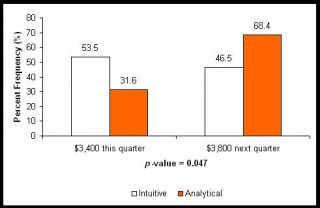
Note that the return from $3,400 to $3,800 is 11.8% in only three months! That is 56% compounded on an annual basis. Thus, the cost of being impatient is quite high. The choices from a sample of financial planners were:

Notice that the analytical planners overwhelmingly selected the patient option ($3,800). A slight majority of the intuitive planners picked the impatient option ($3,400). Shane Frederick found in his much larger sample of a broader section of the population that 60% of the analytical people took the patient option while only 35% of the intuitive people did. More intuitive and analytical planners picked the patient option than in Frederick's general population. Presumably this is because investment professionals understand the implied investment return better.
How much would you pay to get the book tomorrow?
The average amount from Frederick's intuitive people was $4.54.
The analytical people would only pay $2.18.
The difference was even great in my sample of financial planners.
Whether considering payments over time or paying for speedy delivery of a book, intuitive thinkers have less patience than analytical thinkers.
Is it better to be patient or impatient from an investment perspective?  

Thursday, 24 September 2015

Analytical/Intuitive Thinking: PART II, Know Yourself!

The questions are designed so that one answer (the intuitive solution) immediately comes to mind. The correct answer is the analytical solution, however. The most common answers to Shane Fredericks' CRT questions are:
1) If it takes 5 machines 5 minutes to make 5 widgets, how long would it take 100 machines to make 100 widgets? _______ minutes
Analytical answer: 5 minutes
Intuitive answer: 100 minutes
2) In a lake, there is a patch of lily pads. Everyday, the patch doubles in size. If it takes 48 days for the patch to cover the entire lake, how long would it take for the patch to cover half the lake? _________ days
Analytical answer: 47 days
Intuitive answer: 24 days
3) A bat and ball together cost $1.10. The bat costs $1.00 more than the ball. How much does the ball cost? _________ cents
Analytical answer: 5 cents
Intuitive answer: 10 cents
If you got two or three of the analytical answers, then you are an analytical thinker. If you got none or one analytical answers, you are an intuitive thinker. Shane found that the average number of analytical answers for Massachusetts Institute of Technology students was 2.18. Since they tend to be engineering students, this is not surprising. A Harvard choir group average was 1.43 and University of Toledo student average was 0.57.
There are many decision-making activities in which it may be better to be an intuitive thinker. Other situations favor analytical thinkers. What might be better for investing decisions?


One of the principles of Prospect Theory is that people do not have a constant risk aversion. In other words, people may avoid risk in some instances and seek risk in others. For example, we buy lottery tickets (risk seeking) and car insurance (risk avoidance).
Here is another illustration. Read and consider the two choices below.
Which option would you pick? You have the choice to receive either:
(A) $100 for certain, or
(B) flip a coin for a chance to $300 if heads or receive nothing if tails
Which option would you pick? You have the choice to pay either:
(A) $100 for certain, or
(B) flip a coin for a chance to pay nothing if heads or pay $300 if tails


Did you pick the safe alternative (choice A) for both?
 The risky alternative (choice B) for both?
Or did you pick one safe choice and one risky choice?
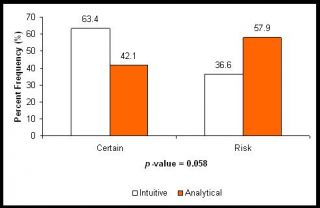
Prospect Theory suggests that the tendency will be to pick the safe option in the first question and the risky option in the second. But not everyone behaves this way. One determinant of choice seems to be the thinking mode. For example, in a sample of financial planners, I found responses for the first question to be:

Add caption
Note that the intuitive thinking planners tended to pick the safe choice when receiving the money while the analytical planners tended to take the gamble. These results are similar to those found by Shane Frederick in his much larger sample of a broader segment of the population. He found that 75% of the analytical people picked the gamble while 53% of the intuitive people picked the safe option. Analytical people may recognize a risk premium in the gamble. On average, people picking the gamble will receive $150 (the expected value of $0 and $300). That is a $50 risk premium over the safe choice.
For the choice of paying money (the second question), the financial planners choose:

Here, the majority of intuitive planners picked the gamble. People are often willing to take risk in order to get back to even. The analytical planners tended toward the safe payment.
Note that both the intuitive planners and the analytical planners tended to pick one safe option and one risky option. Intuitive people picked the safe option in the positive domain (receiving money) and the risky option in the negative domain (paying money). This is consistent with Prospect Theory. The analytical planners did the opposite.
What choices would be better from an investment perspective?

Wednesday, 23 September 2015

Analytical/Intuitive Thinking: PART I, Know Yourself!

Find out whether you are an analytical or intutive thinker!
In 2002, Daniel Kahneman won the Nobel Prize in Economics. That was quite remarkable because he is a psychologist. In his acceptance speech in Stockholm, Sweden, he talked about people relying on reasoning out answers or intuitively knowing answers.
Shane Fredericks designed a short quiz to try to identify a person's thinking mode between analytical and intuitive processes. To determine your thinking mode, take his Cognitive Reflection Test (CRT). Quickly jot down your answers to these three questions:
1) If it takes 5 machines 5 minutes to make 5 widgets, how long would it take 100 machines to make 100 widgets? _______ minutes
2) In a lake, there is a patch of lily pads. Everyday, the patch doubles in size. If it takes 48 days for the patch to cover the entire lake, how long would it take for the patch to cover half the lake? _________ days
3) A bat and ball together cost $1.10. The bat costs $1.00 more than the ball. How much does the ball cost? _________ cents


How good are you at finding what's best? Test your intution and brains

Good decision makers often wind up with the best things available. But how do they do they do it? Finding the best thing involves searching, but it also involves knowing when to stop searching. How good a searcher are you? Do you search too much, or just the right amount?

Psychologists and economists have extensively studied problems of "sequential search" and “optimal stopping”. Fancy terms for a basic idea. Consider this simple game
You have been captured by an evil  dictator. He forces you to play a game. He brings you into a room with many brightly colored gift boxes. Each box has a different amount of money in it. You can open any number of boxes in any order. After opening each box, you can decide to open another box or you can stop. If you say “stop” after opening the box with the most money in it (of all the boxes) you get to live and keep the money. However, if you stop at any other time, you lose and the evil dictator will kill you.
If you were in this situation, what would your strategy be? How likely would you be to survive?
There’s much academic interest in this simple game because it is analogous to many real life situations in which once you pass something, there’s no going back. It’s even been compared to finding the love of your life: people date a number of others looking for that special someone, but if they pass somebody up, there’s no guarantee that he or she will still be single in the future.
So that you can test your brains and intuition  for searching and stopping search, I’ve created a little game:

Tuesday, 22 September 2015

Intuition Helps Us Let Go of Fear of Death

As a physician, I see fear of death permeating our health care system. Doctors shy away from patients who are dying or resort to technical language. Patients are afraid of making the passage. Relatives don't know what to say or do around the death bed. Intuition--our deepest gut feelings and knowing--can guide us if we listen.


All About Fear

Fear is a vital response to physical and emotional danger—if we didn't feel it, we couldn't protect ourselves from legitimate threats. But often we fear situations that are far from life-or-death, and thus hang back for no good reason. Traumas or bad experiences can trigger a fear response within us that is hard to quell. Yet exposing ourselves to our personal demons is the best way to move past them.


DENIAL OF DEATH
I'm always surprised by people who say they're not afraid to die. Most are usually quick to point out they are afraid to die painfully—but not of the idea of no longer being alive. I continue to be mystified not only by this answer but by the number of people who give it. Though I can imagine there are indeed people who, because of their age, character, or religious beliefs, truly do feel this way, I've always wondered if that answer hides a denial so deeply seated it cannot be faced by most.
Certainly, this has been the case with me. I love being here and don't want to leave. I've always spoken openly of my fear of death to anyone who's ever asked (not that many have—I suppose even the question is uncomfortable for most), but I've rarely experienced moments where I actually felt afraid. Whenever I've tried wrapping my mind around the concept of my own demise—truly envisioned the world continuing on without me, the essence of what I am utterly gone forever—I've unearthed a fear so overwhelming my mind has been turned aside as if my imagination and the idea of my own end were two magnets of identical polarity, unwilling to meet no matter how hard I tried to make them.


THE SHATTERING OF A DELUSION
The true significance of my denial wasn't made clear to me, however, until I was diagnosed with Post Traumatic Stress Disorder. The anxiety that began to envelop me at that point was of an entirely different order than I'd ever experienced before. It began to interfere with my ability to function, which made plain to me that what my brush with death—twice—had taken from me was my ability to believe I would never die. Knowing intellectually that death awaits us is quite clearly a different thing from believing it, much in the same way knowing intellectually gravity will make you fall is a different experience from actually swooning at the edge of a parapet at the top of tall building. Ultimately, being ill brought me to the realization, contrary to what I'd always believed in my heart, that there was nothing special about me at all. Like everyone else, I was only a piece of meat that would eventually spoil.
From that point forward, whenever I'd feel a minor twinge in my chest or develop a rash on my arms or my hand would shake for no reason I would become paralyzed with anxiety. Even though I recognized intellectually that my reaction was overblown, every new random symptom I felt caused my doctor's brain to leap to horrifying conclusions simply because I now knew in a way I hadn't before that bad things could actually happen to me. I felt like one of my long-time patients who for as long as I've known him has been consumed by an anxiety so great he'd become like a child in his need for constant reassurance that he would be all right. His anxiety had made him inconsolable and his life a joyless nightmare.
PTSD is often diagnosed in men (and now women) who return from the battlefield, women who've been raped, people who witnessed natural tragedy—in short, in anyone who either has an intense traumatic experience themselves or witnesses one occurring to someone else.


WHAT TO DO NEXT
I'd always considered the shattering of delusion in my life to be a good thing, something that's always brought me more happiness rather than less. And yet here seemed to be an example that contradicted that rule, for around the time I was diagnosed with PTSD I was surely suffering to a degree I never had. Frankly, I was happier before living in denial.
Over time, though, the crippling anxiety of PTSD resolved and I returned to my previous level of functioning. However, even minor injuries or transient symptoms that I would have ignored before now stir up vague feelings of worry. I remain acutely aware to this day that my ability to believe in my invulnerability has been irrevocably ruined.
I've decided, however, that this is a good thing: I've been given the opportunity to challenge my fear of death without actually having to be actively dying. Many others aren't so lucky. I began practicing my religion 20 years ago because I was intrigued by the notion that enlightenment might actually be a real thing, attainable if only the correct path was followed. I've continued because I've had experiences with the practice that have convinced me it has real power to shatter delusions about life.
For me, three things are certain: First, my experiences with my religion so far have inclined me to think that enlightenment is a real thing, and that it might be the solution to my problem with fear of death. But, second, for me to become convinced that life is eternal ("there is no beginning called birth or ending called death"), I must have an experience that proves it to me beyond a shadow of a doubt. I need to know it the way I know gravity is real. I must confess I can't today even conceive of what that experience could be. Yet I must remember that every time I've gained real wisdom  from my Buddhist practice and become genuinely happier, it's always come as a result of having an experience I could never have predicted. And lastly, because I hope the establishment of indestructible happiness based on a belief in the eternity of life is possible, I must remain on guard against the seductive tendency to convince myself of it. Belief that arises from a desire to believe is usually, in my experience, too flimsy to withstand a genuine challenge. And I can think of no more genuine a challenge to a belief in life after death (whether through reincarnation or an ascension to Heaven or anything else) than the actual imminent approach of death itself.
I fully recognize that my current belief about death—that it is truly the final end of the self—is likely to be correct. Which makes me wonder if I wouldn't be better off throwing my energies into re-embracing denial and simply accepting that when it comes my time to die, if I'm given the chance to see it coming, I'll suffer however many moments, hours, days, or weeks of fear there are to suffer and then be granted a final release.
If only I could. Once a delusion has been shattered, I've found there's no going back. And even if there were, at some point I'm certain to be re-confronted with a denial-eradicating sickness or injury. Everyone will. Depending on your current life stage this might not seem like a pressing issue. But shouldn't it be? An experience like mine could become yours at any moment. And even more desirable than being able to die peacefully is being able to live fearlessly. In fact, one of the supposed benefits of manifesting the life-condition of the Buddha is freedom from all fear.
I've tried to resolve my fear of death intellectually and come to the conclusion that it can't be done, at least not by me. Some kind of practice that actually has the power to awaken me to the truth is required (assuming, of course, the truth ends up being what I hope it to be).
Thus, my grand experiment continues. What about yours?

Monday, 21 September 2015

Trusting Intuition

Sometimes we think too much, then become paralyzed in the process.
How do we become effective human beings? It takes the right
combination of thinking, including thinking about others and action. And,
often enough, the right ways of thinking.
The ability to think, to reflect on ourselves and our behavior and
to plan ahead, may be the feature that most defines us as humans, the
crowning glory of evolution. But thinking is not an unmitigated
blessing.
Sometimes people get stuck in it. People are often consumed with
the past, ruminating about events and chewing them over and over. Others
get paralyzed thinking about what lies ahead. Both forms of overthinking
consume the brain 's limited capacity for attention, bring the mind
to a halt and compromise mental health . One form is known as depression ,
the other anxiety. And both conditions are rampant in our culture
today.
Intuition  can be thought of as almost the polar opposite of either.
And it is a reliable way of knowing, and valuable in many
circumstances.
There are many ways to define intuition, but all present a kind of
conundrum. The act of reflecting on intuition is precisely what intuition
isn't. Intuition is really your brain on autopilot, performing its
actions of processing information outside of your awareness that
it's operating. It's nonconscious thinking.
Can you trust intuition? It helps to know that the kind of
automatic information processing that underlies intuition is something
you probably experience all the time.
Consider that phenomenon known as "highway hypnosis."
You drive the car for miles without a conscious thought. You're
steering the car, reacting to road conditions and the actions of other
cars, so obviously your brain is processing incoming information.
You're just not aware of yourself. Or you walk down a street, get
lost in thought and find yourself at your destination without awareness
of the processes that got you there.
It's often safe to rely on automatic nonconscious processes
for rote tasks, but what about more complex situations?
Nonconscious processes operate all the time in complex
decision-making  Often enough, we just don't give them credit.
Often we cite rational-sounding criteria for our feelings and actions and
do not disclose the subjective preferences of feelings that arise
spontaneously.
Sometimes we override our intuitive gut-level reactions altogether,
ignoring our native responses in favor of ways we think, for external
reasons—such as to coincide with the judgments of others—we
should be reacting. Studies have shown that we are capable of making
sound judgments about food and, often, people based on nonconscious
processes, but if we deliberately think about our preferences and
decisions we can actually make them worse. The truth is that all of the
factors that influence our reactions just aren't available to our
conscious selves.
There is no substitute for gathering information about any task or
situation before us. But neither should we be afraid of not knowing every
reason why we feel the way we do in every situation.

Sunday, 20 September 2015

Big Purchases Benefit from Intuition, but not Stock Picks


Our brains have a number of innate capacities, but they grow out of ancestral, not modern, problems, says Terry Burnham, author of Mean Markets and Lizard Brains. The types of dilemmas we are good at solving intuitively are ones in which the old machinery lines up well to produce positive contemporary outcomes. Investing is not among these.
Any gut feeling you may have about where to put your money is probably very similar to many others' gut feelings (say, going with a stock that has been on the upswing for a while). It's simply not investment-savvy to pick the same stocks as everyone else—you will not stand to gain.
Burnham advises that you set up a system to ensure that your prefrontal cortex, and not your gut, is firmly in charge of financial decisions. You need to analyze investment strategies and information about different companies. Just as Burnham refuses to get the key to the mini bar in hotel rooms lest he give in to a late-night junk-food craving, he "locks in" his money by making sure he can't change his allocations without an adviser's authorization. That way, he won't move his money around on a whim.
Intuition, however, is a reliable source of purchasing decisions, at least for big-ticket items. The only goal of investing money is to make a profit; cold calculations count. Material possessions, on the other hand, have a subjective value—you want products to bring some ease, comfort, or happiness.
When it comes to complex acquisitions such as homes and cars, consumer satisfaction is greater among buyers who decide with their gut. The experience of living in a house is ultimately an emotional and unpredictable one; so throw away your spreadsheet and rely on your "old brain" to assess whether or not you'll get more pleasure than pain out of the purchase. Resume rational deliberation for the little stuff; research shows it is superior to intuition for picking items such as oven mitts and shampoo.
It's comforting to know you can lean on your unconscious when facing big life questions. And, even better, you've got a mind that can both listen to the gut and keep it in line

Saturday, 19 September 2015

MORALITY COMES FROM THE GUT


We think of moral decisions as the raw material of great drama—as warring internal desires or puzzles to solve via logical arguments. But most people actually determine whether an action is right or wrong automatically, finds Jonathan Haidt, associate professor of psychology at the University of Virginia and author of The Happiness Hypothesis. Haidt likens moral intuitions to aesthetic judgments: We instantly know whether we think something is beautiful, but we don't necessarily know why. "The rational mind is like a press secretary that spins reasons for our intuitive moral decisions," he says.
The "press secretary" is all about advancing our own interests, prosecuting those we don't like and defending ourselves. Haidt theorizes that we have evolved this way because of the competitive advantage attached to being able to navigate society's dense web of gossip . Because what people think you do is just as important as what you do, it pays to be able to explain your behaviors in a rosy light. That makes the internal machinery inherently self-deceiving. You may have no qualms about cheating on  your taxes, but you'll probably think twice after speaking with friends about it (if you dare even bring it up).
That's why Haidt does not advocate going with your gut when contemplating a moral decision. "The general advice I would give is to check with others to see what they think." We can see the splinter in our neighbor's eye, after all, but not the plank in our own.


A Strong Hunch can be the Beginning of a Beautiful Relationship

We've all heard stories of couples who "just knew" the moment they met that something serious was going to develop between them. (David Myers, professor of psychology at Hope College and the author of Intuition, had that feeling about a young woman as a teenager; they've been married for more than 40 years now.) The heart has reasons which reason does not know. But maybe the "heart" is governed by the unconscious emotional pattern matching that produces intuitions.
The phenomenon  is as an overall feeling that someone would be "good for you," perhaps even irrespective of passion. "It's tapping into your unconscious and triggering prior emotional experiences. We need to trust that this is a survival system that has evolved to our benefit," he says.
As choosing a mate is rife with unknowns, it's not best arrived at by number crunching. Here is a story of how Ben Franklin advised his nephew, torn between two sweethearts, to list each woman's qualities, place a numeric value on the importance of those qualities, and total each column. But when a friend did just that and calculated the winner, his heart sank. That's how the friend knew he really wanted the other woman

Friday, 18 September 2015

GUT FEELINGS

Intuition really does come from the gut. It's also a kind of matching game based on experience. There are times when trusting your gut is the smartest move—and times you'd better think twice.


You "know" things. You don't even know how you know them. Yet you have a sense of certainty when driving down a strange street that you really must make a left turn. Or comfort a co-worker who insists she's fine. Or quit your job and move to Paris.
Intuitions, or gut feelings , are sudden, strong judgments whose origin we can't immediately explain. Although they seem to emerge from an obscure inner force, they actually begin with a perception of something outside—a facial expression, a tone of voice, a visual inconsistency so fleeting you're not even aware you noticed.
Think of them as rapid cognition  or condensed reasoning that takes advantage of the brain's built-in shortcuts. Or think of intuition as an unconscious associative process. Long dismissed as magical or beneath the dignity of science, intuition turns out to muster some fancy and fast mental operations. The best explanation psychologists now offer is that intuition is a mental matching game. The brain takes in a situation, does a very quick search of its files, and then finds its best analogue among the stored sprawl of memories and knowledge. Based on that analogy, you ascribe meaning to the situation in front of you. A doctor might simply glance at a pallid young woman complaining of fatigue and shortness of breath and immediately intuit she suffers from anemia.
The gut itself literally feeds gut feelings; think of butterflies in the stomach when a decision is pending. The gut has millions of nerve cells and, through them, a "mind of its own," Still, gut feelings do not originate there, but in signals from the brain.
That visceral punch in the paunch is testament that emotions are an intrinsic part of all gut feelings. "I don't think that emotion and intuition can be separated," says cognitive scientist Alexandre Linhares at the Brazilian School of Business and Public Administration. Emotion guides how we learn from experience; if you witness something while your adrenaline is pumping, for instance, it will be remembered very vividly.
Experience is encoded in our brains as a web of fact and feeling. When a new experience calls up a similar pattern, it doesn't unleash just stored knowledge but also an emotional state of mind and a predisposition to respond in a certain way. Imagine meeting a date who reminds you of loved ones and also of the emotions you've felt toward those people. Suddenly you begin to fall for him or her. "Intuition, can be described as 'almost immediate situation understanding as opposed to 'immediate knowledge.' Understanding is filled with emotion. We don't obtain knowledge of love , danger, or joy; we feel them in a meaningful way."
Encased in certainty, intuitions compel us to act in specific ways, and those who lack intuition are essentially cognitively paralyzed. Psychologist Antoine Bechara at the University of Southern California studied brain-damaged patients who could not form emotional intuitions when making a decision. They were left to decide purely via deliberate reasoning. "They ended up doing such a complicated analysis, factoring everything in, that it could take them hours to decide between two kinds of cereal," he says.
While endless reasoning in the absence of guiding intuitions is unproductive, some people, including President Bush, champion the other extreme—"going with the gut" at all times. Intuition, however, is best used as the first step in solving a problem or deciding what to do. The more experience you have in a particular domain, the more reliable your intuitions, because they arise out of the richest array of collected patterns of experience. But even in your area of expertise, it's wisest to test out your hunches—you could easily have latched on to the wrong detail and pulled up the wrong web of associations in your brain.
When researcher Douglas Hofstadter is starting a knotty math problem, for instance, he begins with a hunch. Then he hunkers down and calculates. After two weeks, perhaps he'll see a roadblock and give up. Another hunch pushes him to a new tack, and perhaps it is the right one.
It's time to declare an end to the battle between gut and mind—and to the belief that intuitions are parapsychological fluff. Better to explore how the internalized experiences from which gut feelings arise best interact with the deliberate calculations of the conscious mind.